Research
The Marias islands are an extremely important area for biodiversity. In 2010, they were declared a UNESCO biosphere reserve and described as a “reservoir” for endemic terrestrial species. A transition zone between biogeographic regions, the islands sit at the start of the Eastern Tropical Pacific, the world’s most productive ocean, and at the entrance of the Sea of Cortez, one of the most biodiverse areas of water globally. Additionally, they are located on the continental shelf’s edge, with the Middle-America Trench dropping >4000m only ~5km from shore, and in an area of seasonal upwelling. These unique environmental conditions suggest high cetacean diversity, and experts believe that rare/threatened cetacean species inhabit the archipelago. However, there is virtually no available information on cetacean presence.
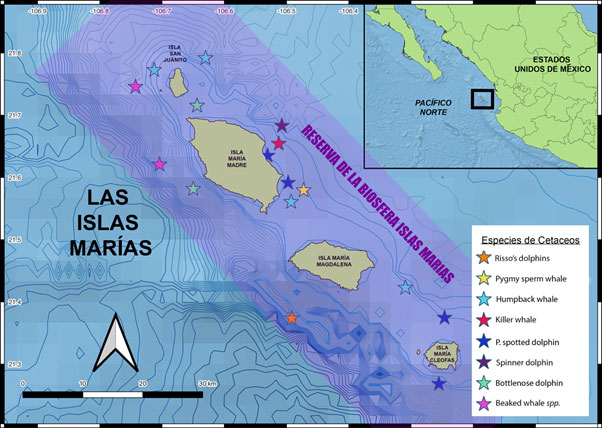
Our first dedicated surveying of the reserve over 10 hours in March 2024, and we found many species!
In 2019, the prison closure was announced. Since 2023 limited tourism has been allowed, but activity is heavily controlled and most areas off-limits. Baseline cetacean information is urgently needed before tourism access/infrastructure grows. Plans are in place to fully open the islands in the future. World-class fishing, diving and surfing are still prohibited. Mexico is number six globally for number of international visitors annually, and tourism one of the country’s most important industries. Both government and private investors recognise the potential of the Marías to become a world-famous tourist destination. It is essential we identify the presence and habitat use of cetacean species of the Marías now. Data that we collect can be directly used to manage the development of tourism of the islands, and to identify areas of critical cetacean habitat that will need special management and restrictions.
Objectives:
- Identify cetacean species and distribution in the oceanic/coastal waters around the Marías Islands via visual and acoustic research.
- Evaluate the habitat use of different cetacean species and their seasonal variations and relationship with regional oceanographic variables.
- Assess the genetic distinctness of cetacean populations of the Marías Islands and relationship with other nearby populations.
Methodologies:
We undertake monthly vessel surveys to the Marias departing from nearby fishing villages and conducted in “pangas” (small, open-hulled fibreglass boats with outboard engines 70–150hp). Methodology used on board involves photo-identification of cetaceans encountered (using photographs to identify species and individuals), drone videogrammetry and acoustic recordings using handheld hydrophones.
In between monthly vessel surveys, in water passive acoustic devices will be deployed at predetermined locations around the islands to record cetacean acoustic during month-long-period between surveys. We will leave two before departing the islands and collect them and replace them with two more each month. Recordings will be analysed using PamGuard and Raven software to identify cetacean species presence.
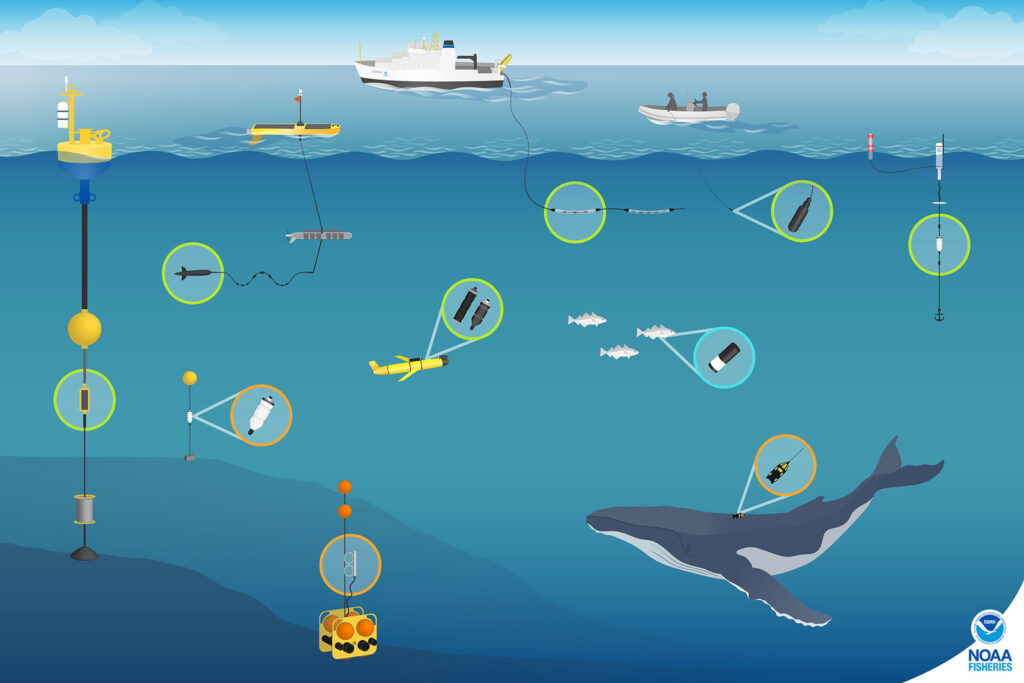
*Different types of acoustic monitoring of cetaceans (Image: NOAA Fisheries).